
1. Introduction: The Mathematics of E-Commerce Growth
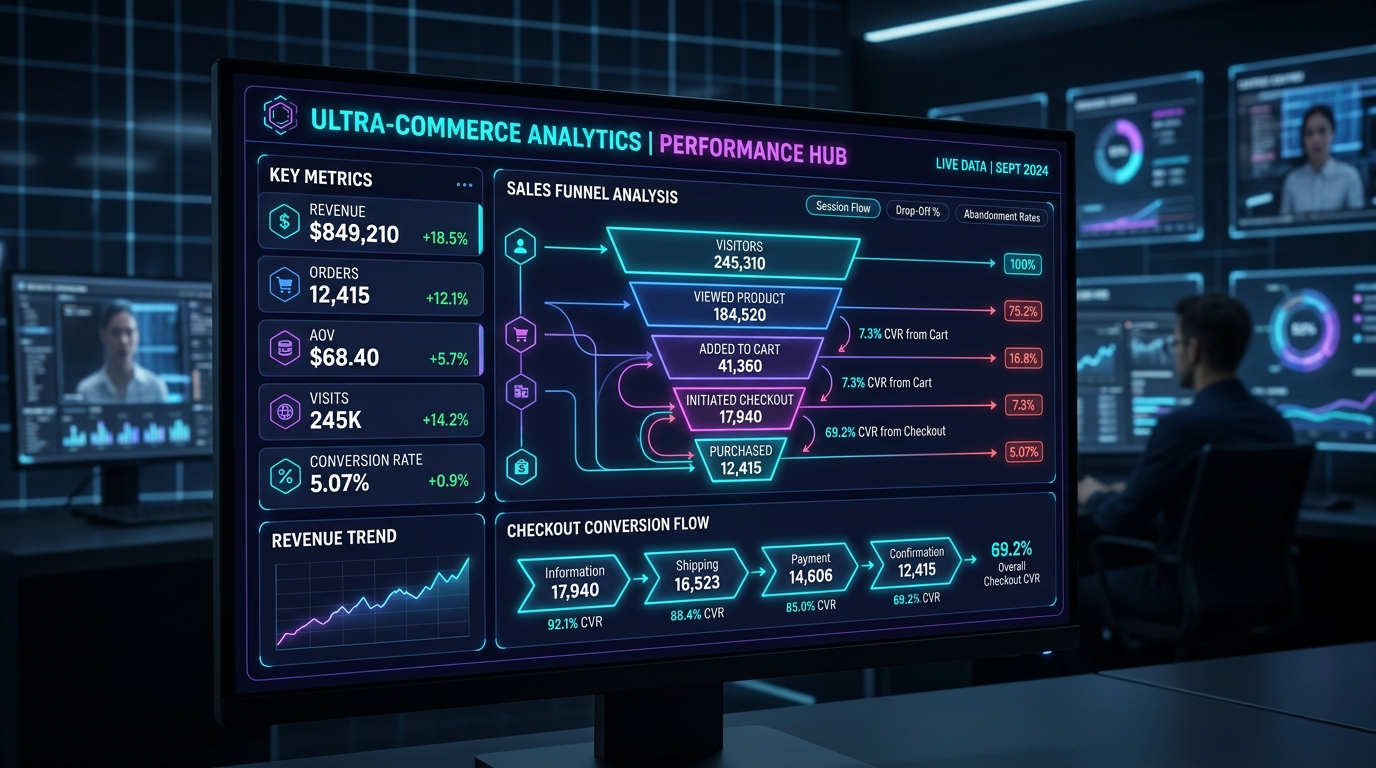
Driving target traffic to an e-commerce storefront is increasingly expensive. As Pay-Per-Click (PPC) advertising costs climb across Meta, Google Ads, and TikTok, relying solely on traffic acquisition to scale revenue erodes profit margins. Conversion Rate Optimization (CRO) is the systematic methodology of turning a higher percentage of existing storefront visitors into paying customers.
Consider the compounding financial impact: Increasing an online store's conversion rate from 1.5% to 3.0% doubles your total revenue without spending an additional dollar on ad spend. Achieving this efficiency requires eliminating every point of friction along the customer journey, from initial landing page discovery to post-purchase confirmation.
Utilizing high-performance custom e-commerce storefront development ensures storefronts are engineered on lightning-fast Next.js architecture designed specifically for conversion velocity and catalog scalability.
2. Page Load Velocity & Real User Experience (RUX) Impact
In online retail, page speed is directly correlated with customer purchase intent. Modern online shoppers expect instantaneous page transitions. If a Product Detail Page (PDP) takes more than 2 seconds to render, user engagement drops sharply, and shopping cart abandonment spikes.
Quantifying Speed-to-Revenue Impact
- Sub-1 Second Load Times: Stores loading within 500ms achieve 2x to 3x higher conversion rates compared to stores loading in 3+ seconds.
- Mobile Device Sensitivity: Over 70% of online commerce transactions occur on smartphones over cellular networks. Mobile users abandon slow PDPs within 3 seconds.
- Core Web Vitals Thresholds: Google's Interaction to Next Paint (INP) directly impacts checkout button response times. Micro-delays during tap events frustrate users, causing cart exits.
By leveraging server-side HTML pre-rendering and localized asset caching, custom Next.js storefronts deliver sub-300ms catalog views that keep shoppers engaged through the entire buying funnel.
High-Resolution Product Media without Speed Penalties
Shoppers rely on visual detail to build purchase confidence. Utilizing modern image formats (AVIF and WebP) combined with explicit aspect ratios prevents layout shifts while serving crisp product photos optimized dynamically for mobile viewports.
3. Product Detail Page (PDP) Layout Architecture
The Product Detail Page is the critical decision zone of any online store. A high-converting PDP must instantly convey value, answer customer objections, build visual trust, and present an unmistakable Call-to-Action (CTA).
Key Architectural Elements of a Winning PDP
- Above-the-Fold Visual Hierarchy: Position main product imagery, clear product titles, star rating badges, pricing, and the main Add to Cart button above the smartphone screen fold.
- Sticky Mobile Add-to-Cart Bar: As users scroll down to read long product descriptions or customer reviews, maintain a persistent, fixed CTA bar at the bottom of the screen.
- Interactive Variant Selection: Update color swatches, sizing guides, and inventory availability in real-time without triggering full page reloads.
- Clear Value Micro-Copy: Highlight shipping timelines (e.g. "Ships in 24 Hours"), return policies ("30-Day Risk-Free Guarantee"), and payment terms ("4 interest-free payments") directly adjacent to the CTA.
Designing user-centric product interfaces relies on modern e-commerce UI/UX design principles to guide shoppers seamlessly toward conversion.
4. Streamlining Checkout Funnels & Digital Wallet Integration
The checkout funnel represents the final barrier to revenue capture. Traditional checkout processes featuring multi-page registration forms, mandatory account creation, and manual credit card number typing result in cart abandonment rates over 70%.
Eliminating Checkout Friction Strategies
- One-Tap Digital Wallets (Apple Pay & Google Pay): Support biometric one-tap authentication. Mobile shoppers can authorize payment and auto-fill verified shipping addresses using Touch ID or Face ID in under 5 seconds.
- Frictionless Guest Checkout: Never force users to construct and verify a new password before buying. Allow guest checkout by default, offering optional account creation on the order confirmation screen.
- Single-Page Accordion Checkout: Consolidate shipping, billing, and order summary into a clean single-page accordion layout to reduce perceived steps.
- Real-Time Address Auto-Complete: Integrate Google Places API or address verification services to minimize address typing errors on mobile keyboards.
5. Trust Signals, Social Proof & Risk Reversal
Online buyers naturally feel hesitation when purchasing from a new store. Building instant credibility requires embedding psychological trust triggers across every touchpoint:
/* Trust Architecture Blueprint */
1. Social Proof: Verified Buyer Ratings & User Generated Photo Reviews
2. Security Badges: PCI-DSS Compliance Icons & SSL 256-Bit Shielding
3. Risk Reversal: Explicit Money-Back Guarantees & Free Return Labels
4. Live Proof Widgets: Recent Purchase Notifications & Inventory Urgency Triggers
Reviewing real-world storefront builds across e-commerce case studies demonstrates the conversion impact of strategic trust architecture.
6. Headless E-Commerce: Decoupling Frontends for Speed
Legacy monolithic e-commerce platforms (such as traditional monolithic stores) tie the front-end presentation layer directly to backend database logic. Every time a user clicks a product variant or adds an item to cart, the entire server must render heavy liquid templates and process complex database scripts, introducing lag.
Headless E-Commerce architecture decouples the front-end user experience (built using Next.js and hosted on global edge networks) from the backend commerce engine (Shopify, Commerce Layer, or custom Node.js APIs). The result is sub-300ms page transitions, zero layout shifts, and total visual customization freedom.
7. E-Commerce Technical SEO & Structured Product Schemas
Maximizing conversion rates requires attracting high-intent shoppers who are ready to purchase. Integrating structured JSON-LD Product schema markup enables search engines to display rich snippet data (live prices, stock status, star ratings, and review counts) directly on Google SERPs.
Executing continuous technical SEO search engine optimization ensures dynamic schema injection for catalog routes, driving qualified organic shopping traffic straight to PDPs.
8. Dynamic Personalization & A/B Testing Methodologies
Conversion optimization is an ongoing scientific discipline. Top-performing brands run continuous A/B multivariate tests to validate design changes before full rollout:
- Headline & Value Proposition Testing: Test emotional vs. feature-focused hero section headlines.
- CTA Button Color & Wording: Test high-contrast action colors (e.g., lime green vs. vibrant cyan) and urgency wording ("Claim Yours Now" vs. "Add to Cart").
- Cross-Sell & Upsell Placements: Offer complementary products inside an slide-out cart drawer (In-Cart Upsells) to increase Average Order Value (AOV).
9. Comprehensive 10-Point E-Commerce CRO Audit Checklist
Audit your online storefront against this 10-point conversion optimization checklist:
- ✔ Verify mobile product page load speeds are under 1.5 seconds on cellular connections.
- ✔ Ensure the main "Add to Cart" button is visible above the fold on mobile screens.
- ✔ Implement a persistent sticky bottom CTA bar on long product detail pages.
- ✔ Enable one-tap mobile digital payment wallets (Apple Pay, Google Pay, Shop Pay).
- ✔ Provide frictionless guest checkout without forced account registration.
- ✔ Display shipping costs, delivery estimates, and tax calculations transparently upfront.
- ✔ Embed verified buyer review star ratings and customer photos near product titles.
- ✔ Display SSL security badges and PCI-compliance shields near payment forms.
- ✔ Inject dynamic Product JSON-LD schemas to earn rich snippets on Google Search.
- ✔ Implement slide-out cart drawers featuring one-click upsells to maximize AOV.
10. Summary: Transforming Visitors into Repeat Customers
Conversion Rate Optimization transforms casual website traffic into sustainable online revenue. By removing purchasing friction, accelerating mobile load speeds, integrating digital wallets, and presenting clear trust elements, your store maximizes profit margins on existing marketing channels.
Store owners looking to scale online storefront conversion rates can schedule an e-commerce technical consultation.