
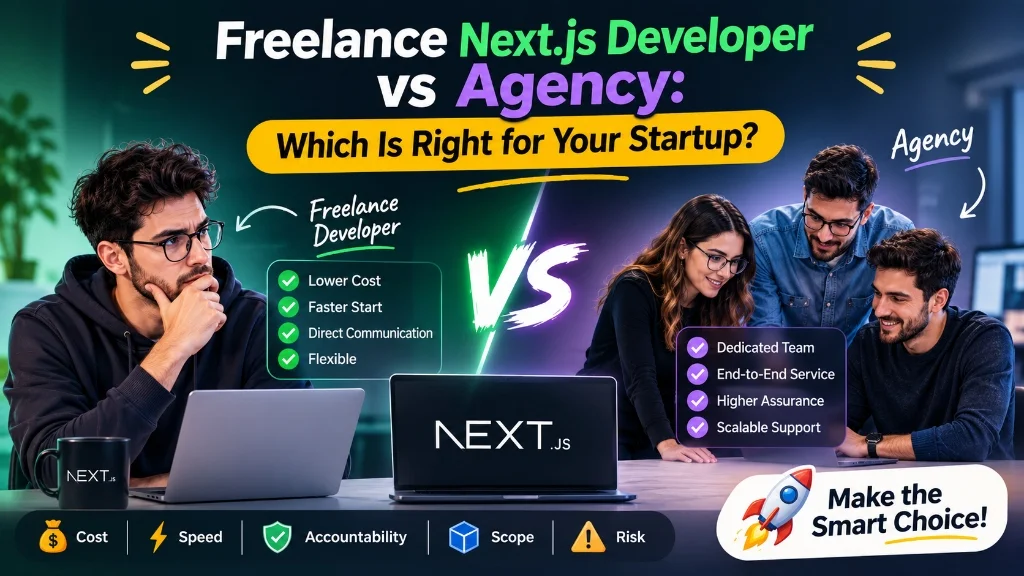
Choosing who builds your product is one of the first big decisions a startup makes, and it is easy to get wrong. A freelancer looks cheaper and faster. An agency looks safer and more complete. Both impressions are partly true, and both can mislead.
The better question is which option fits your project, your timeline and the amount of management you can take on. This guide compares a freelance Next.js developer against full-service agencies on cost, speed, accountability, scope and risk, then explains when each is the stronger choice and what a hybrid arrangement looks like.
Early-stage founders across startups and SaaS face this crucial resource allocation choice when building their initial product with limited seed capital.
What You Are Actually Choosing Between
A freelance Next.js developer is an independent professional who takes on projects directly. You usually deal with one person, who may handle design implementation, front-end and back-end work, deployment and sometimes SEO.
A Next.js development agency is a company with several people, often including developers, designers, a project manager and QA. You deal with an account or project lead, and the work is spread across a team.
There is also a middle ground: small studios and senior freelancers who work with a few trusted collaborators. The labels matter less than what is actually included in the engagement, so judge each option on its process and track record.
Cost: What Each Option Really Includes
Hourly or project rates tend to be lower for freelancers, because they carry fewer overheads. Agencies charge more because their price covers more: project management, design input, QA, account handling and cover when a team member is away.
That makes direct rate comparisons unreliable. Two quotes for the same project may include different things, and the cheaper one may leave out testing, documentation or post-launch support.
Examining regional standards for Next.js developer hourly rates in the US, UK and UAE explains how to benchmark pricing structures fairly against international market tiers.
Analyzing project drivers behind Next.js website development cost clarifies what pushes engineering budgets up or down across custom web builds.
Judge cost by total project outcome, not hourly rate. A lower rate attached to slow progress or heavy rework can cost more than a higher rate attached to a clean delivery.
Speed and Availability
Freelancers: can often start quickly and make decisions without internal approvals. A focused senior developer working alone can move fast on a well-defined project. The risk is capacity: if they are ill, overbooked or leave for another opportunity, progress can stall, and there is nobody to step in.
Agencies: usually need more time to scope and staff a project, but can run several workstreams in parallel once underway. Design, development and QA can overlap. For larger builds, that parallel capacity can shorten the schedule, although larger teams also introduce coordination overhead.
Ask any provider for a realistic timeline, what it depends on, and what happens if a key person becomes unavailable.
Accountability and Process
This is where the two options differ most in practice.
With an agency, accountability is structural. A project manager monitors milestones, QA catches defects before you do, and a contract with a registered company gives you a clear party to hold responsible. The trade-off is that you sometimes deal with intermediaries rather than the person writing the code.
With a freelancer, accountability is personal. You speak to the person doing the work, which means faster answers and fewer misunderstandings. But process varies widely. A strong freelancer uses version control, staging environments, written scopes and documented handovers. A weaker one may not.
Whichever route you pick, look for the same basics:
- A written scope with deliverables and exclusions
- Milestones with staging links you can review
- Code in a repository you own
- A defined process for changes and revisions
- Documentation at handover
Scope: Who Covers What
A Next.js project rarely involves code alone. Consider the other work that goes into a successful launch:
- UX and visual design
- Content structure and SEO setup, including metadata, redirects and sitemaps
- Integrations with payments, CRMs or analytics
- Testing across devices and browsers
- Deployment, monitoring and backups
- Ongoing maintenance
Agencies often cover most of these under one roof. Freelancers may cover some directly and rely on partners or your own team for the rest. Neither is wrong, but you must know in advance who is responsible for each piece. Gaps in responsibility are a common source of delays and disputes.
Risk: What Can Go Wrong
Every option has failure modes.
Freelancer risks
- Single point of failure: Illness, burnout or a change of plans can halt work.
- Knowledge concentration: If only one person understands the codebase, handover problems follow.
- Variable quality control: There may be no second pair of eyes reviewing the code.
- Limited breadth: One person may not be equally strong in design, back end, SEO and DevOps.
Agency risks
- Cost: Higher overheads mean higher prices.
- Junior handoffs: The people you meet during the sales process are not always the ones doing the work, so ask who will be on your project.
- Slower decisions: Layers of process can slow changes.
- Template thinking: Some agencies apply a standard approach whether or not it fits your product.
Reducing risk means asking direct questions: who will work on this, what is their experience, how is work reviewed, and what happens if someone is unavailable?
When a Freelance Next.js Developer Is the Better Fit
A freelancer tends to work well when:
- The project is clearly defined and moderate in size, such as a marketing site, a landing page set or a focused MVP
- You have, or can access, design and content resources
- You are comfortable managing scope and priorities yourself
- Budget is tight and you want direct access to the person building the product
- You need a specialist to join an existing team for a defined task, such as performance tuning or a migration
When an Agency Is the Better Fit
An agency is often stronger when:
- The project spans several disciplines at once, such as design, development, content and SEO
- You want a single accountable party and have little time to manage the work
- Deadlines are tight and several people need to work in parallel
- The product is complex or business-critical, and you want built-in QA and redundancy
- You expect an ongoing relationship with support, maintenance and iteration
The Hybrid Option
Many startups find that neither pure option fits. A hybrid takes the strengths of both: a senior engineer who works directly with you, backed by agency-style process.
In practice that means:
- One accountable lead: who writes or oversees the code and answers directly for the result
- Documented process: written scope, milestones, staging links, code review and handover notes
- Access to collaborators: such as a designer or QA tester when the project needs them
- A support arrangement: after launch, so you are not left alone with the codebase
The goal is to get the speed and directness of working with a specialist without taking on the delivery risk that often comes with a one-person arrangement.
Our hybrid website design and development service combines direct senior-engineer communication with structured agency-grade delivery.
A Checklist for Deciding
Answer these questions before you request quotes:
- How well-defined is the scope? Clear requirements suit fixed-price work with either option. Vague ones need discovery first.
- How much management time do you have? If little, favour an option with built-in project management.
- What skills are you missing? Design, SEO, DevOps or QA gaps point towards a broader team.
- How critical is continuity? If the product will need years of support, consider how knowledge is shared and documented.
- What is your tolerance for delivery risk? Be honest about what a delay or failure would cost your business.
Practical guidance on hiring a remote web developer across the USA, UK and Europe covers contracts, time zone alignment, and IP ownership.
When you evaluate candidates, ask for live Next.js projects you can inspect, speak to past clients if possible, and request a written proposal that states what is and isn't included.
Frequently Asked Questions
Is a freelance Next.js developer cheaper than an agency?
Usually the hourly or project rate is lower, but total value depends on what is included. Agency prices often cover design, QA and project management that a freelancer quote may not.
Can a freelancer handle an entire startup MVP?
Often yes, if the scope is clearly defined and the freelancer has full-stack experience. Complex products with heavy design or integration needs may benefit from additional support.
What should I ask before hiring either option?
Ask who will do the work, to see comparable live projects, how code is reviewed and delivered, how changes are handled, who owns the code, and what support is available after launch.
Can I switch from a freelancer to an agency later, or the reverse?
Yes, but it is far easier when the code is well organised, documented and stored in a repository you control. Insist on that from the start.
Conclusion
There is no universally right answer between a freelance Next.js developer and an agency. Freelancers offer directness and lower overheads, agencies offer breadth and structure, and a hybrid arrangement can combine the strengths of both. Decide based on your scope, your available management time and your tolerance for risk, then check the details: who does the work, how it is reviewed, what is included, and what happens after launch. A clear written scope and a process you can inspect will protect you with either option.
To discuss whether a dedicated senior developer or a hybrid delivery sprint suits your roadmap, reach out through our engineering consultation.