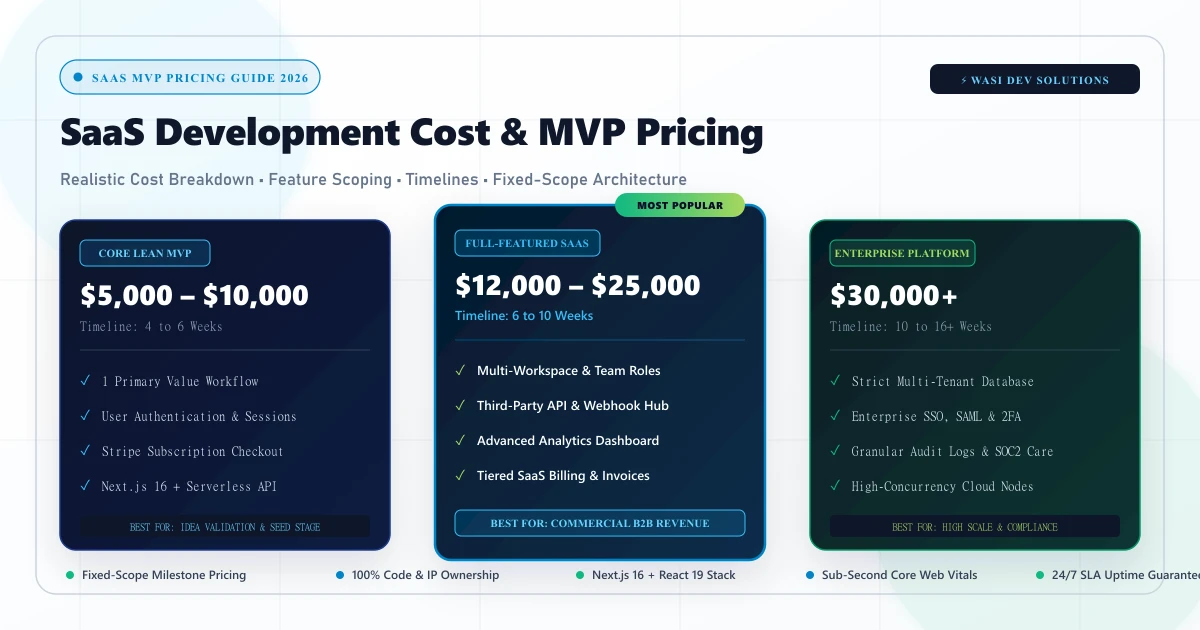
Ask ten agencies what a SaaS product costs and you will get ten different answers, and most of them will be technically correct. The price depends on what you build, who builds it, how many integrations it needs, and how much you want to launch with.
A simple internal tool and an enterprise multi-tenant platform are both classified as cloud software, but they sit at opposite ends of the budget range. Investing in professional custom web applications and SaaS development ensures that your product is architected for clean scalability and predictable infrastructure costs.
This guide explains what drives SaaS development cost, where the money goes in a minimum viable product (MVP), and how to cut spending without cutting the parts that matter. It deliberately avoids quoting a single number, because a figure without a defined scope behind it is not a useful estimate.
Executive Budget Summary.
SaaS development cost is determined by scope, architectural complexity, and team structure. Control budget by launching a narrow, one-workflow MVP, validating UX with interactive Figma prototypes before writing code, and budgeting for post-launch maintenance retainers from day one.
What an MVP Actually Is in SaaS Development
An MVP is the smallest version of your product that solves one real problem for a specific group of users.
It is not a prototype that falls apart, and it is not a stripped-down copy of the finished vision. It is a fully functional, production-ready product with a disciplined, narrow scope.
A high-converting MVP usually includes:
- A Single Core Workflow: The primary automated feature that delivers the software's main commercial value.
- User Accounts & Authentication: Secure session handling, password resets, and team invite flows.
- A Clean Management Interface: An intuitive dashboard that allows customers to operate that core workflow without confusion.
- Automated Billing Infrastructure: Integrated Stripe subscription handling if you charge users from day one.
- Production-Grade Cloud Infrastructure: Reliable hosting, error telemetry, and database backups to support early adopters.
Everything else, such as advanced analytics, granular role permissions, public developer APIs, and native mobile apps, can wait until real paying users request them. Every extra feature added during the MVP stage exponentially increases design, development, and testing overhead.
The Core Formula Behind Every SaaS Estimate
Strip away industry jargon and almost every software estimate follows a straightforward formula: the hours required multiplied by the hourly rate of the engineers doing the work, plus the third-party services the product depends on.
That means total cost is governed by three primary variables:
- Scope: More features, additional dashboards, and complicated edge cases directly translate to higher developer hours.
- Team Model: A solo freelancer, a boutique engineering agency, and a large legacy consultancy price their work very differently, offering varying degrees of code quality, delivery speed, and risk management.
- Architectural Complexity: Real-time WebSockets, multi-tenant database partitioning, and asynchronous background jobs take significantly longer to build than standard form inputs and database tables.
When comparing vendor quotes, always compare the detailed scope first. A cheap quote that omits essential infrastructure or database security is not a discount, it is an expensive liability.
Main Factors That Affect SaaS Development Cost
1. Features and Business Logic
Features are the largest cost driver. A tool that simply displays and stores customer records requires far less engineering than one that calculates dynamic forecasts, schedules recurring jobs, and triggers multi-channel alerts.
The more business rules your platform enforces, the more developer hours are required to build, test, and maintain edge cases.
2. UI and UX Design Engineering
Design is never mere decoration in SaaS. A confusing user interface triggers high user churn, and potential subscribers judge software credibility within minutes of onboarding.
A rigorous design phase includes user journey mapping, wireframing, and interactive design systems. Investing early in conversion-focused UI/UX design services saves substantial capital because modifying Figma prototypes is ten times cheaper than refactoring production code.
3. Authentication, Roles, and Multi-Tenancy
Basic user sign-up and login are relatively straightforward. Costs increase when you require organization workspaces, role-based access control (RBAC), single sign-on (SSO), and strict tenant data isolation.
Multi-tenant architecture, where multiple corporate clients securely share the same database while keeping their records partitioned, requires careful upfront planning. Retrofitting multi-tenancy into a single-tenant application later is an expensive engineering undertaking.
4. Billing and Recurring Subscriptions
Accepting recurring payments involves far more than embedding a checkout form. You must programmatically manage tier upgrades, prorated billing, failed payment webhooks, automatic invoice generation, regional taxes, and cancellation flows.
Payment gateways like Stripe provide robust APIs, but integrating them securely with your internal database logic takes dedicated engineering time.
5. Third-Party API Integrations
Every external integration, whether with a CRM, accounting platform, transactional email gateway, or cloud API, introduces technical complexity. Each service has its own rate limits, authentication protocols, and failure modes that require defensive coding.
6. Security, Compliance, and Data Governance
Any application handling customer personal data, financial transactions, or health records must prioritize security from day one. Audit logging, role permissions, automated backups, and encrypted secrets are mandatory architectural requirements, not optional add-ons.
7. Infrastructure and Ongoing Operational Overhead
Software development is only one component of your budget. Serverless hosting, managed cloud databases, APM monitoring, transactional email delivery, and customer support tools create recurring monthly bills that grow alongside your active user base.
Where the Money Goes in a Typical SaaS MVP
The software development lifecycle generally breaks down into these distinct phases:
| Project Phase | Key Deliverables | Budget Impact |
|---|---|---|
| Discovery & Scope | User stories, system architecture diagram, schema design | Eliminates expensive mid-build scope creep |
| UI/UX Design | Interactive clickable Figma prototype & design system | Ensures rapid front-end developer velocity |
| Core Engineering | Front-end components, API routes, database models, Stripe logic | Largest allocation of development hours |
| QA & Security Testing | End-to-end payment testing, authorization checks, edge cases | Guarantees smooth, bug-free public launch |
| DevOps & Deployment | Serverless CI/CD pipeline, SSL, database automated snapshots | Protects uptime and data integrity |
Skipping the discovery phase to save money is one of the most frequent founder mistakes. Vague specifications lead to mid-project code refactoring, which is the costliest form of development.
Realistic Timelines: What to Expect
Timeline and development cost are inextricably linked. A realistic schedule prevents budget blowouts.
At Wasi Dev Solutions, our custom SaaS MVP builds typically complete within four to eight weeks, depending on integration complexity. Be cautious of vendors promising full-featured SaaS applications in days; rushed timelines inevitably compromise code structure, security, and scalability.
Proven Strategies to Cut SaaS Cost Without Cutting Quality
- Narrow the MVP Scope: Build one complete, polished workflow instead of five mediocre features. Add features only when requested by paying subscribers.
- Leverage Battle-Tested Cloud Services: Authentication, transactional emails, and subscription billing are solved problems. Use established platforms like Supabase, Clerk, and Stripe rather than reinventing the wheel.
- Adopt Modern Mainstream Frameworks: Building on Next.js, React, and Node.js guarantees access to massive open-source ecosystems, extensive documentation, and competitive engineering talent.
- Finalize UI Design Before Coding: Lock in screens, form validations, and user navigation in Figma prior to engineering sprints.
- Execute in Structured Milestones: Launch the core product first, then reinvest initial subscriber revenue into secondary features.
Never compromise on database security, automated daily backups, end-to-end payment verification, or modular code architecture. Technical shortcuts in these areas lead to catastrophic outages down the road.
Fixed-Price vs. Hourly Billing Models
The contract structure determines how financial risk is distributed between you and your development partner:
- Fixed-Scope Pricing: You receive an upfront, itemized budget and timeline for a clearly agreed scope. This model protects early-stage founders by capping financial exposure and holding the development team accountable for delivery.
- Time and Materials (Hourly): Offers flexibility for continuous experimentation, but carries uncapped financial risk if requirements shift during the build.
For early-stage SaaS MVPs, a fixed-scope milestone engagement provides the greatest predictability and cost discipline.
Budgeting for Life After Launch
Software is never truly finished on launch day. Framework dependencies require regular updates, security vulnerabilities must be patched, and active users will uncover unanticipated edge cases.
Securing an ongoing application maintenance and support retainer guarantees 24/7 uptime monitoring, scheduled backups, and rapid issue resolution at a fraction of the cost of emergency repairs.
Furthermore, SaaS founders must pair their product interface with an optimized marketing storefront. Our specialized web development for SaaS startups and tech companies ensures that your public marketing site and internal web app share coherent branding, lightning-fast Core Web Vitals, and seamless conversion paths.
How to Get an Accurate SaaS MVP Estimate
To receive an itemized, realistic project quote, prepare the following specifications before reaching out to an engineering agency:
- A concise summary of the core user pain point and target audience.
- The top three to five primary user interactions inside the dashboard.
- Mandatory third-party API integrations (CRM, payment provider, email gateway).
- Target go-to-market deadline.
- Reference software products with interfaces or workflows you admire.
Ready to Build Your SaaS Product on Time and Within Budget?
Get a transparent, fixed-scope proposal with itemized milestones, clean React/Next.js architecture, and 100% intellectual property ownership.
Get a Fixed-Scope SaaS MVP Quote