A website is never really finished. The day after launch, software dependencies begin to age, web browsers change how they behave, security issues are discovered, and content starts to go out of date.
Without someone responsible for keeping things in order, a site that worked perfectly at launch slowly turns into a business risk: slower, less secure, and harder to repair when something finally breaks. Protecting your digital investment with professional website maintenance services ensures that your platform operates with 99.9% uptime, pristine security, and reliable performance.
Investing in structured website maintenance plans puts a dedicated engineer or agency in charge of that upkeep for a fixed monthly investment. This guide explains what a comprehensive plan includes, how providers price their services, how to compare agreements, and which red flags to avoid before signing.
Executive Maintenance Summary.
Dedicated website maintenance plans protect revenue by automating security patches, off-site cloud backups, and 24/7 uptime monitoring. Pairing routine code maintenance with ongoing technical SEO audits prevents ranking loss and eliminates unexpected emergency repair fees.
What Is a Website Maintenance Plan?
A maintenance plan is a recurring service agreement in which a developer or agency looks after your website after it goes live.
Instead of calling someone only during an emergency, you pay a predictable fee in exchange for scheduled upkeep and a defined service level agreement (SLA).
It is easy to confuse maintenance with adjacent services, so it helps to clarify the boundaries:
- Hosting: Provides the cloud server hardware where your files reside. It does not mean anyone is monitoring or updating your application code.
- Development: Encompasses engineering new features or custom design templates. Maintenance focuses on keeping existing code fast, secure, and compatible.
- Marketing and SEO: Aims to attract qualified traffic. Maintenance protects the technical foundation that organic search depends on.
Think of it like servicing a commercial vehicle. Routine oil changes and brake inspections do not make the engine faster, but neglecting them guarantees catastrophic failure on the road.
What a Solid Website Maintenance Plan Must Include
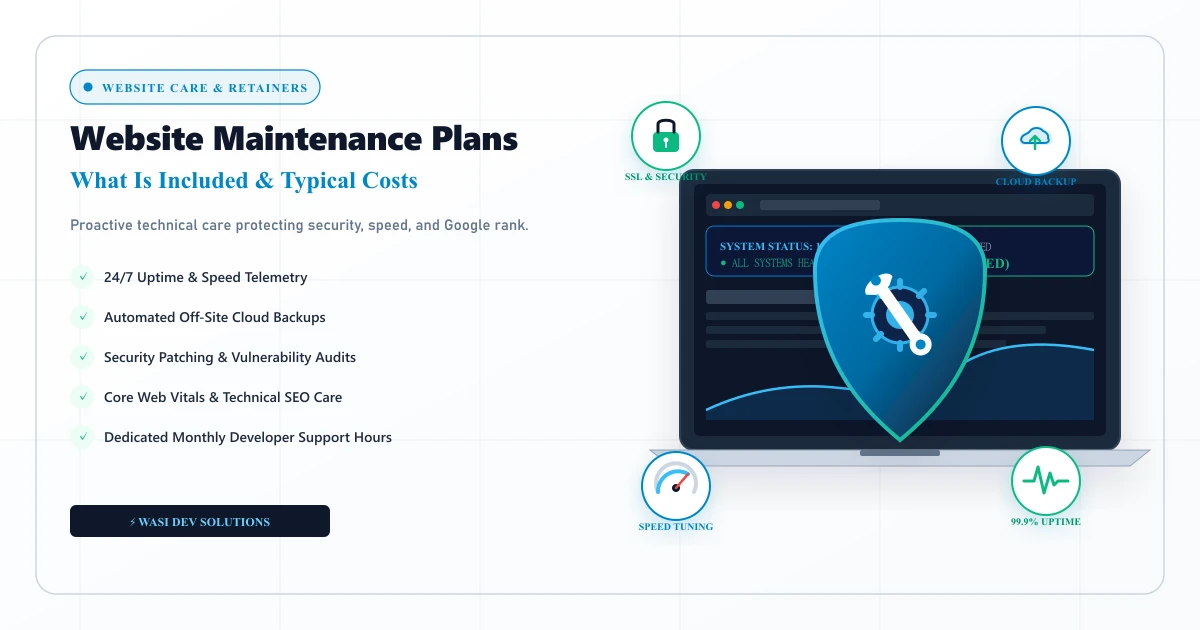
Agreements vary across service providers, but the most reliable website maintenance plans consistently cover the following non-negotiable core responsibilities:
1. Security Updates and Continuous Vulnerability Monitoring
Outdated software remains the number one attack vector for malicious web intrusions. This vulnerability affects every platform.
A WordPress installation relies on core, theme, and plugin updates. A modern Next.js or JavaScript application depends on npm packages that regularly receive security advisories. A quality plan provides scheduled dependency patching, automated malware scanning, SSL certificate renewals, and strict HTTP security headers.
2. Restorable Off-Site Backups
Backups only possess value if they can be restored swiftly during a crisis.
Always verify how often backups execute, where archives are stored, and how long snapshots are retained. Storing backup archives on the same physical server as the website represents a critical vulnerability, because hardware corruption destroys both copies simultaneously. True enterprise plans store redundant copies in separate cloud regions.
3. Real-Time Uptime Telemetry
Monitoring systems probe your endpoints at continuous intervals and alert engineers immediately upon downtime.
Without automated uptime telemetry, business owners often discover an outage hours later when an annoyed buyer complains. Your service contract should explicitly define who receives alerts and the guaranteed emergency response window.
4. Core Web Vitals and Performance Auditing
Websites accumulate technical debt over time as media libraries expand, third-party analytics tags multiply, and stylesheets grow.
A maintenance plan should incorporate periodic speed audits, specifically evaluating Google Core Web Vitals: Largest Contentful Paint (LCP), Interaction to Next Paint (INP), and Cumulative Layout Shift (CLS). Catching performance degradation early protects your organic search rankings.
5. Content Updates and Minor Developer Edits
Most contracts include a monthly allotment of developer hours for day-to-day administrative tasks, such as updating leadership bios, refreshing price sheets, or publishing landing pages.
Ensure your agreement clearly distinguishes between minor content edits and custom feature development to avoid billing disputes.
6. Proactive Bug Resolution
Components break unexpectedly following third-party API changes, payment gateway updates, or modern browser releases.
Your contract should state whether debugging and resolving these anomalies is covered within the retainer or invoiced at an ad-hoc hourly rate.
7. Monthly Transparency Reporting
A concise monthly executive report summarizing applied updates, monitored uptime, security scans, and recommendations demonstrates the tangible return on your investment. If a provider cannot document their monthly actions, you cannot accurately assess their value.
8. Fundamental SEO Health Checks
Premier retainers also audit crawl errors, missing meta tags, redirect chains, and broken hyperlinks. If organic search drives your customer pipeline, pairing maintenance with dedicated technical SEO and performance engineering protects your search engine footprint.
Review our comprehensive guide on Next.js SEO best practices and speed optimization to understand how clean technical architecture preserves top search positions.
How Maintenance Work Differs by Platform Architecture
While the fundamental objectives remain universal, day-to-day engineering workflows depend heavily on your technology stack:
| Platform Architecture | Primary Maintenance Tasks | Typical Vulnerability Focus |
|---|---|---|
| WordPress CMS | Weekly plugin updates, theme patches, database spam cleanup | Third-party plugin security holes and database bloat |
| Next.js Custom Code | npm package audit, edge deployment verification, build testing | Dependency CVE patches and serverless API endpoints |
| E-Commerce & Web Apps | Payment gateway webhooks, cart flow testing, database index tuning | Checkout failures, webhook timeouts, and user session bugs |
Custom Next.js platforms feature a fundamentally different operational profile compared to monolithic CMS tools. Because there is no insecure public admin dashboard, maintenance revolves around verifying static builds, updating React packages, and managing edge delivery networks.
How Much Do Website Maintenance Plans Cost?
There is no universal pricing figure, because the monthly cost of website maintenance plans depends directly on technical complexity, traffic volume, and support speed.
Your monthly investment is governed by several core parameters:
- Site Scale and Complexity: A corporate presentation website requires significantly fewer engineering hours than an e-commerce platform processing hundreds of daily orders.
- Technology Infrastructure: Custom full-stack applications demand senior developer expertise rather than basic administrative dashboard oversight.
- SLA and Emergency Response Guarantees: 24/7 incident response with a one-hour resolution window commands a premium over standard next-business-day email ticketing.
- Bundled Developer Hours: Plans that include dedicated hours for new layout creation cost more than preventative update-only tiers.
Common Maintenance Pricing Models Compared
- Fixed Monthly Tiers: You receive a transparent package with guaranteed deliverables and defined developer hours. This structure provides the greatest budget predictability for commercial businesses.
- Hourly Blocks: You purchase a set block of developer time each month. While flexible, hours may expire if unused depending on provider rollover terms.
- Ad-Hoc Emergency Support: You pay exclusively when an outage occurs. While seemingly inexpensive initially, hourly rates for emergency recovery are exorbitant and response times are never guaranteed.
Critical Questions to Ask Before Signing an Agreement
- What specific deliverables are executed every single month, and what triggers an additional invoice?
- Are software updates tested thoroughly on an isolated staging copy prior to production deployment?
- Where are off-site backups located, and how long does a complete disaster recovery restoration take?
- What is the guaranteed response time for revenue-critical incidents?
- Who performs the actual work, senior engineers or outsourced subcontractors?
- Do I retain 100% intellectual property ownership of all custom code, hosting credentials, and digital assets?
Warning Signs and Red Flags to Avoid
- Vague Descriptions: Ambiguous promises of full support without an itemized checklist of monthly duties inevitably cause project friction.
- Absence of Disaster Testing: An untested backup protocol is effectively zero backup protection.
- Unrealistic Guarantees: No agency can truthfully promise that any internet-connected system is 100% immune to outages or zero-day exploits.
- Proprietary Lock-In: If an agency refuses to provide full administrative credentials or restricts source code portability, you are exposing your business to severe operational risk.
Selecting the Ideal Level of Care for Your Platform
When evaluating different website maintenance plans, consider your actual business model. A simple informational brochure site with minimal code changes may only require off-site backups, security patches, and basic uptime checks.
A growth-oriented lead generation website must incorporate monthly Core Web Vitals tuning and ongoing content updates. A commercial web portal or SaaS platform requires continuous error logging, high-priority developer hours, and database optimization.
Partnering with the engineering agency that developed your platform, such as through our custom website design and development services, provides unmatched efficiency because the engineers possess intimate familiarity with your underlying codebase. For advanced platforms, the same advantage applies to our custom web application engineering retainers.
Protect Your Website with Proactive Engineering Care
Explore our transparent website maintenance plans to eliminate security risks, prevent unexpected downtime, and keep your site loading in under one second with dedicated developer support.
See Our Monthly Maintenance Plans