A founder asking "how much will our app cost?" rarely gets a straight answer, and that is not evasion. The honest answer depends on scope, and the same MERN stack can power a simple dashboard or a multi-role platform with payments, notifications and admin tooling.
This guide does not quote a single price, because any one figure would be wrong for most projects. It explains what drives mern stack development cost, where a startup budget typically goes, how to compare quotes, and how to scope an MVP so you spend on what proves your idea rather than on features nobody has asked for.
What the MERN Stack Includes
Modern founders building digital platforms in startups and SaaS frequently select MERN because unified JavaScript accelerates MVP delivery and keeps initial engineering lean.
MERN stands for MongoDB, Express.js, React and Node.js. MongoDB is a document database, Express and Node.js handle the server and API layer, and React builds the user interface. Because the whole stack uses JavaScript, one developer or a small team can work across front end and back end, which is one reason it is popular with early-stage companies.
That shared language can reduce handoffs and speed up early development. It does not make a project cheap by default. Cost comes from the work required, not from the technology label.
What Drives MERN Stack App Development Pricing
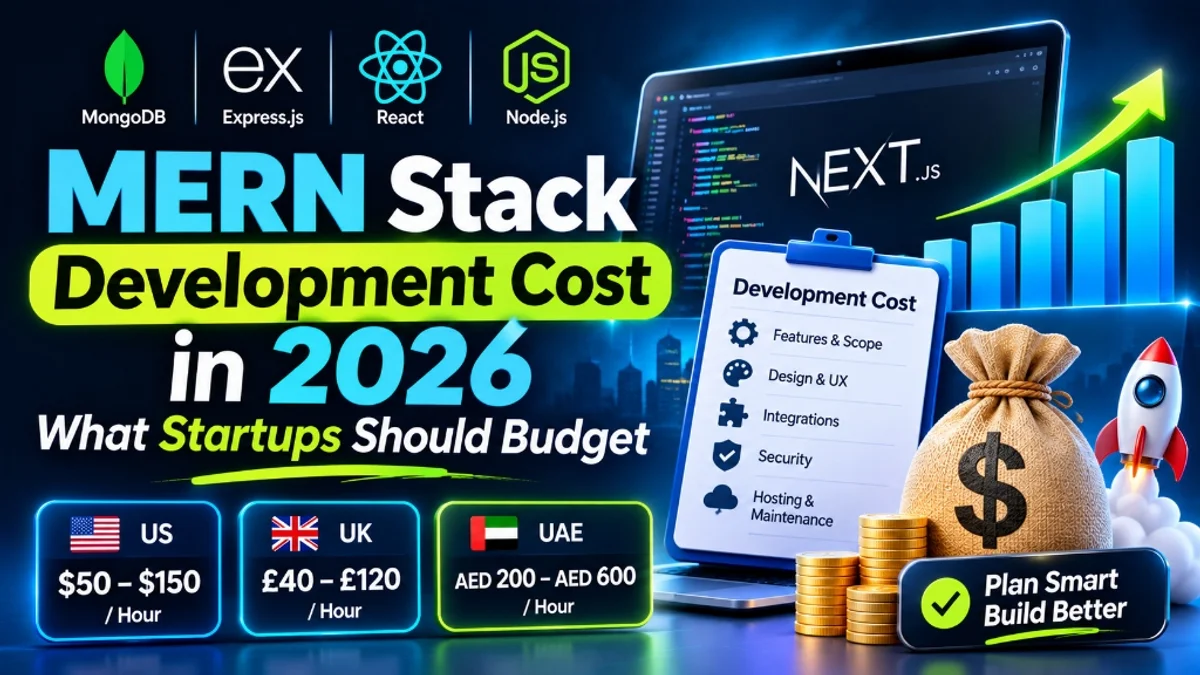
When assessing overall mern stack development cost, several architectural and operational factors directly influence your final estimate:
Scope and feature count
Every feature is a cost. A login page, a profile screen and a basic list view take far less time than role-based permissions, search, file uploads and reporting. The most reliable way to control cost is to shrink the feature list, not to hunt for a lower hourly rate.
Design and user experience
A clean, functional interface built from a standard component library costs less than a fully custom design system with animations and detailed responsive layouts. Decide early how much polish the first release needs. For an MVP, clarity usually matters more than visual flair.
Authentication, roles and security
Sign-up, password reset, email verification, social login, multi-factor authentication and permission levels each add work. Applications handling payments or personal data also need extra care with validation, access control and secure storage. This is not an area to economise on.
Third-party integrations
Payment providers, email and SMS services, maps, analytics, CRMs and calendar tools save you from building those features yourself, but each integration needs setup, testing and error handling. Integrations with poor documentation or unusual requirements take longer than expected.
Data complexity
MongoDB is flexible, but your data model still needs planning. Applications with many related entities, reporting needs or imports from existing systems require more design and testing than a simple record-keeping tool.
Real-time and advanced features
Live chat, notifications, collaborative editing, dashboards that update instantly and background jobs all add technical complexity. They are often worth building later, once you know users want them.
Testing, deployment and infrastructure
Automated tests, a staging environment, a deployment pipeline, monitoring and backups are the parts of a project that stop it from breaking quietly. They are easy to skip when budgets are tight, and expensive to retrofit.
Where the Budget Actually Goes
Most startup builds divide spending across a handful of areas to calculate the real custom web app cost for startups. The proportions vary, but the categories are consistent:
- Discovery and planning: defining users, features, data and priorities before any code is written.
- UI/UX design: wireframes, screens and interaction flows.
- Front-end development: the React interface, state management and responsive behaviour.
- Back-end development: APIs, business logic, database design and authentication.
- Integrations: payments, email, third-party services.
- Quality assurance: manual and automated testing, bug fixing.
- Deployment and infrastructure: hosting, environments, CI/CD and monitoring.
- Project management and communication: often built into an agency rate, sometimes billed separately by freelancers.
Planning is the line item founders most often want to cut, and it is usually the one that saves the most. Changing a feature on paper costs very little. Changing it after it has been built, tested and connected to other features costs much more.
Costs Outside the Build
The first release is not the full cost of owning software. Budget for these as well:
- Hosting and services: servers, database hosting, email and monitoring tools, usually billed monthly.
- Licences and third-party fees: payment processors, SMS or map providers, and design tools.
- Maintenance: dependency updates, security patches and bug fixes after launch.
- Iteration: real users will reveal problems and opportunities that planning cannot.
- Content and data preparation: writing, imagery, and migrating existing records.
A common rule of thumb is to keep a reserve for post-launch changes. Rather than treat it as a failure, treat it as the stage where the product becomes useful.
How to Scope an MVP Without Overspending
Keeping your initial mern stack development cost under control requires ruthless prioritization during the mvp budget planning stage. An MVP, or minimum viable product, is the smallest version of your product that lets real users do the one thing it exists for. It is not a cheaper copy of the finished product. Use this process to define it:
- Write down the core problem. State in a sentence who the user is and what job they need done.
- List every feature you can imagine, then rank them. Sort them into must-have, should-have and later. Be strict. A feature belongs in the first group only if the product fails without it.
- Define the main user journey. Map the shortest path from sign-up to value. Anything outside that path is a candidate for phase two.
- Choose proven components. Use established libraries for authentication, forms, tables and payments rather than building custom versions.
- Plan phases. Release a focused first version, gather feedback, and then fund the second phase using what you learned.
Detailed financial models for product roadmaps, outlined in SaaS development cost and MVP pricing, demonstrate that prioritizing user retention loops over extensive feature matrices keeps initial engineering spend predictable.
Comparing Quotes Fairly
Two proposals for the same app can differ widely, and the cheaper one is not always the better value when evaluating mern developer rates. When you compare, check that each quote clearly states:
- the features and screens included, and what is excluded
- the team's experience with similar applications
- who handles design, testing and deployment
- how changes to scope are handled and priced
- what happens after launch, including support or warranty periods
- who owns the source code and accounts
Ask each provider to explain their assumptions in plain language. A vague estimate with a low headline price usually hides gaps that surface later as change requests.
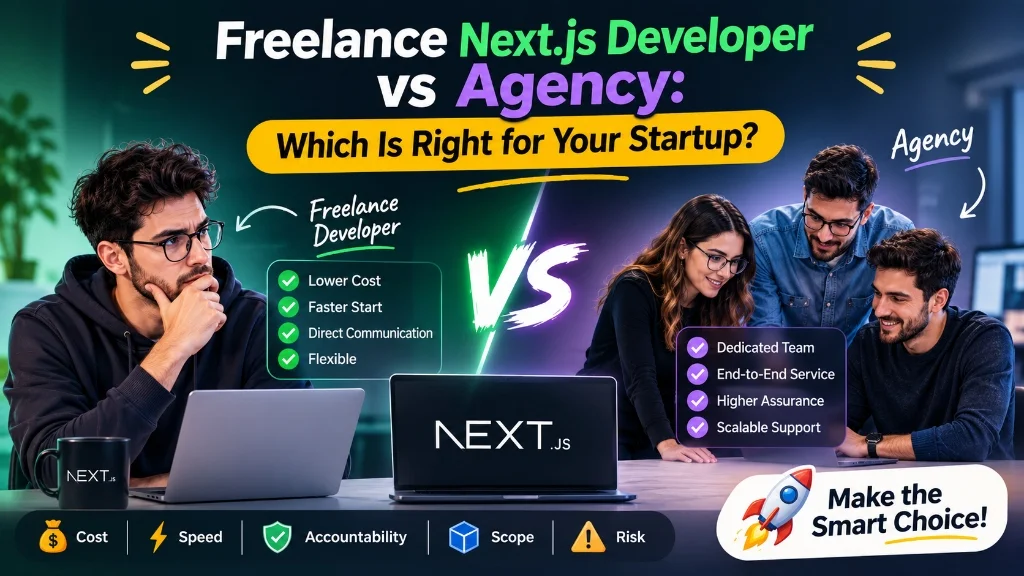
If you're deciding between hourly and fixed pricing, remember that hourly billing suits uncertain, evolving work, while fixed scope suits well-defined requirements. Many startups use a hybrid: a fixed-price planning phase, followed by a capped or fixed build, then a monthly retainer. You might also weigh whether a framework like Next.js fits better than a plain React single-page app. When deciding whether to build a pure client-rendered SPA or adopt a server-rendered alternative, analyzing Next.js and React for business websites clarifies which framework delivers the right balance of SEO visibility and interactivity for your market.
When MERN Is the Right Choice, and When It Isn't
Architecting a platform with horizontal auto-scaling, structured database indexing, and decoupled microservices follows the principles of scalable web application development to ensure your stack withstands user growth without requiring costly structural rewrites.
MERN suits applications with dynamic interfaces, flexible data structures and teams that want one language across the codebase. It is a sensible choice for dashboards, marketplaces, internal tools and many SaaS products.
It is not automatically the best fit. Heavily relational data, such as financial records with strict consistency requirements, may be better served by a relational database. Content-driven sites that depend on search visibility can benefit from server-side rendering, which a plain React front end does not provide on its own. A good developer will tell you when MERN is a poor match, so ask directly.
Planning Your Budget
Before requesting quotes, prepare a short brief: your target users, the core journey, must-have features, required integrations, any compliance needs, and your launch timeline. The clearer the brief, the more accurate and comparable the estimates will be. Engaging a tailored custom web application development service provides structured milestone planning that eliminates mid-project scope creep.
Building a Custom Web App or MVP and Need a Transparent Scope?
We help founders architect and build scalable full-stack web applications on clear, fixed-price milestones with zero technical debt and clean code ownership.
Explore Our Custom Web Application Services →Conclusion
MERN stack development cost is shaped by scope far more than by the stack itself. Define the one problem your product solves, rank features ruthlessly, plan before you build, and budget for hosting, maintenance and iteration as well as development. Compare quotes on what they include rather than on the headline number. That approach keeps spending tied to learning from real users, which is what an MVP is for.
If you have an application brief ready for scoping or want a transparent architectural review before investing in development, reach out via our contact page to receive a detailed breakdown of deliverables and milestones.