Most agencies know the moment. A client asks why their site isn't ranking, and the answer sits in places the account team can't easily reach: crawl budget, rendering, canonical logic, redirect rules, Core Web Vitals. The strategy is sound. The problem is technical, and nobody on staff can read it or fix it.
Professional white-label technical SEO audits solve that problem. A specialist does the audit, your agency presents it under its own name, and the client gets a clear picture of what is wrong and what to do about it. This guide explains what a resellable audit contains, how engagements are usually structured and priced, and how to avoid the mistakes that make white-label work go badly.
What White-Label Technical SEO Means
White-label work is produced by one company and delivered to the end client under another company's brand. In technical SEO, that typically means a specialist or developer crawls and analyses the site, writes up findings and recommendations, and hands the report to the agency to present as its own.
It differs from general agency SEO subcontractor arrangements in one respect. Technical SEO is partly an engineering discipline, so the partner may need to read code, inspect server responses and understand frameworks, not just review rankings. Delivering dependable white-label technical SEO gives marketing agencies a credible technical bench without hiring a full-time white-label SEO developer, while ownership of the client relationship stays firmly with the agency.
Why Agencies Resell Technical Audits
Marketing consultancies and creative firms in professional services frequently encounter bandwidth bottlenecks when enterprise retainers demand deep code audits beyond regular marketing deliverables. A few practical reasons come up repeatedly:
- Capacity: Audits are bursts of focused work. Hiring for them full-time rarely makes sense.
- Depth: Some problems, such as JavaScript rendering failures or complex redirect logic, need hands-on engineering experience.
- Retention: A well-run audit gives clients a documented roadmap, which tends to lead to follow-on work.
- Speed: A partner with a tested process can usually turn audits around faster than an agency learning each step for the first time.
The trade-off is control. You depend on another team's quality, so selecting the partner matters more than the price.
What a Resellable Audit Should Contain
A report that only lists tool warnings isn't a deliverable. Clients and their stakeholders want to know what matters, why, and what happens next. A strong audit usually covers the following areas.
Crawlability and indexation
This section checks whether search engines can reach and index the right pages. It looks at robots.txt rules, meta robots and X-Robots-Tag directives, XML sitemap quality, canonical tags, orphan pages and the Page indexing report in Google Search Console. It is often where the most damaging problems turn up, because a page that cannot be indexed cannot rank.
Site architecture and internal linking
Here the auditor examines click depth, navigation, URL structure, and whether important pages receive enough internal links. Findings might include pages buried deep in the site, thin hub pages, or inconsistent URL patterns.
Status codes and redirects
Broken links, 5xx errors, redirect chains and loops, and internal links pointing at redirected URLs all belong here. Fixes are usually concrete and easy to verify, which makes them popular with clients.
On-page technical signals
Title tags, headings, meta descriptions, structured data and hreflang annotations for multi-region sites are checked for presence, duplication and errors. Structured data should be validated with Google's testing tools rather than assumed correct.
Rendering and JavaScript
For sites built with modern frameworks, the audit should compare raw HTML with rendered output and confirm that critical content and links are visible to crawlers. Reviewing client-side execution against Next.js SEO best practices confirms why rendering strategy deserves its own section in any audit of a JavaScript-heavy site.
Performance and Core Web Vitals
Core Web Vitals reports in Search Console, PageSpeed Insights and Lighthouse help identify slow templates and unstable layouts. Lab and field data can disagree, so a careful auditor reports both and explains the difference. Optimizing server response times and asset compression aligns with the performance standards explored in Core Web Vitals and LCP in Next.js.
Mobile, security and international setup
Mobile rendering, HTTPS configuration, mixed content and, where relevant, language and region targeting round out the technical review.
Tools Behind the Work
Professional audits generally combine several data sources rather than trusting any single one. Common choices include a crawler such as Screaming Frog, a backlink and site audit platform such as Ahrefs, Google Search Console, Google Analytics, PageSpeed Insights and Lighthouse, and browser developer tools for inspecting responses and rendering.
Tools surface symptoms. The auditor's job is to interpret them, discard false alarms, and connect issues to business impact. Systematically prioritizing fixes against a proven technical SEO checklist for modern websites outlines the exact scope a thorough agency review should cover.
The Deliverable Format That Clients Actually Use
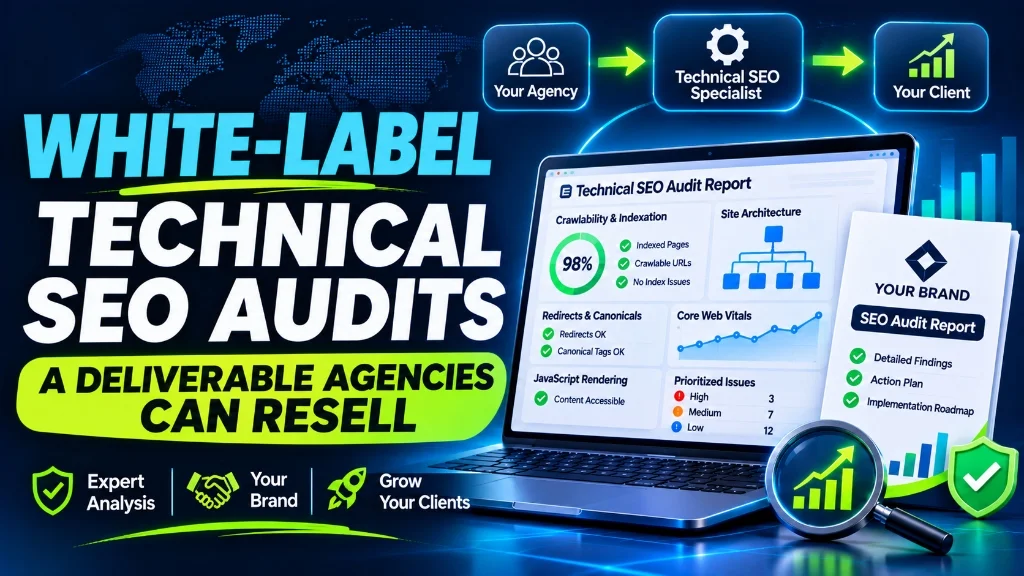
The report is what your client sees, so format matters as much as findings. A usable audit tends to include:
- An executive summary in plain language, written for a non-technical decision-maker.
- A prioritised issue list, with each item tagged by impact, effort and affected URLs.
- Evidence, such as screenshots, example URLs and tool exports, so findings can be verified.
- Specific recommendations, written so a developer can act on them without guessing.
- A roadmap that sequences fixes into phases.
- A spreadsheet or task list the agency can import into its project management tool.
The branding should be entirely yours: your logo, your template, your language. Good partners also provide a short briefing for the account manager so they can present findings confidently and answer follow-up questions.
Turnaround, Scope and Pricing Models
Specific prices vary by partner and market, so treat any single figure you read online with caution. What you can compare are the structures.
Common pricing models
- Fixed price per audit: Simple to resell, because you know your cost before quoting the client. Works best when scope is defined clearly.
- Tiered by site size or complexity: A small brochure site, a large e-commerce store and a JavaScript web app need different effort, so tiers keep pricing fair.
- Hourly or day rate: Suits exploratory or unusually messy work, but gives you less certainty on margin.
- Retainer: Ongoing monitoring and periodic re-audits, often paired with implementation support.
What affects turnaround
Turnaround depends on site size, platform, access to data and how quickly the client provides credentials. Agree up front what the partner needs: Search Console and analytics access, staging access if relevant, and any previous audits. Delays usually come from missing access rather than analysis.
How Implementation Upsells Work
The audit often reveals more work than the client can do alone. Many agencies therefore add implementation as a second service: a fix package covering redirects, canonical and metadata corrections, structured data, performance improvements or template changes.
This works best when audit and implementation sit with the same partner, since the person who found the problem knows exactly how to fix it, and handoffs shrink. Make sure the scope of fixes is priced separately and described clearly, so the client sees the audit as a diagnostic and the fixes as a distinct, optional project.
Protecting Your Brand and Your Client
Before trusting a partner with client work, confirm:
- Confidentiality: A signed NDA, and a clear policy on not contacting your clients directly.
- Branding control: Reports carry no trace of the partner's identity unless you choose otherwise.
- Data handling: How credentials are shared, stored and revoked after the project.
- Ownership: You and your client own the deliverables and any code or configuration produced.
- Communication: Who answers client questions, and how quickly.
- Quality review: A process for checking findings before the report reaches you.
Ask for a sample report. It will show you more about their thinking than any sales page.
Choosing the Right Partner
Look for evidence of technical depth, not just tool familiarity. When evaluating an engineering team for white-label technical SEO, key questions include how they validate findings, how they handle JavaScript frameworks, whether they can implement the fixes they recommend, and how they communicate when a client disputes a finding. If you work with agencies on both audit and build, engaging an experienced technical SEO and performance service ensures diagnostics translate directly into codebase-level execution.
Looking for an Unbranded Technical SEO Partner for Your Agency?
We deliver unbranded, client-ready technical audits and code-level fixes under strict NDAs, giving your agency a dependable engineering bench.
Explore Agency Partner Services →Conclusion
A white-label technical SEO audit lets an agency offer a specialist service without building a specialist team. The value lies in a clear, prioritised deliverable: findings backed by evidence, recommendations a developer can act on, and a roadmap the client understands. Choose a partner on technical depth and process rather than price alone, define scope and access before work starts, and treat implementation as a natural next step. Done well, the audit becomes the start of a longer client relationship.
If your agency is ready to expand margins with unbranded audits or needs senior developers to resolve complex technical issues under your banner, reach out via our contact page to discuss confidential partnership terms.