
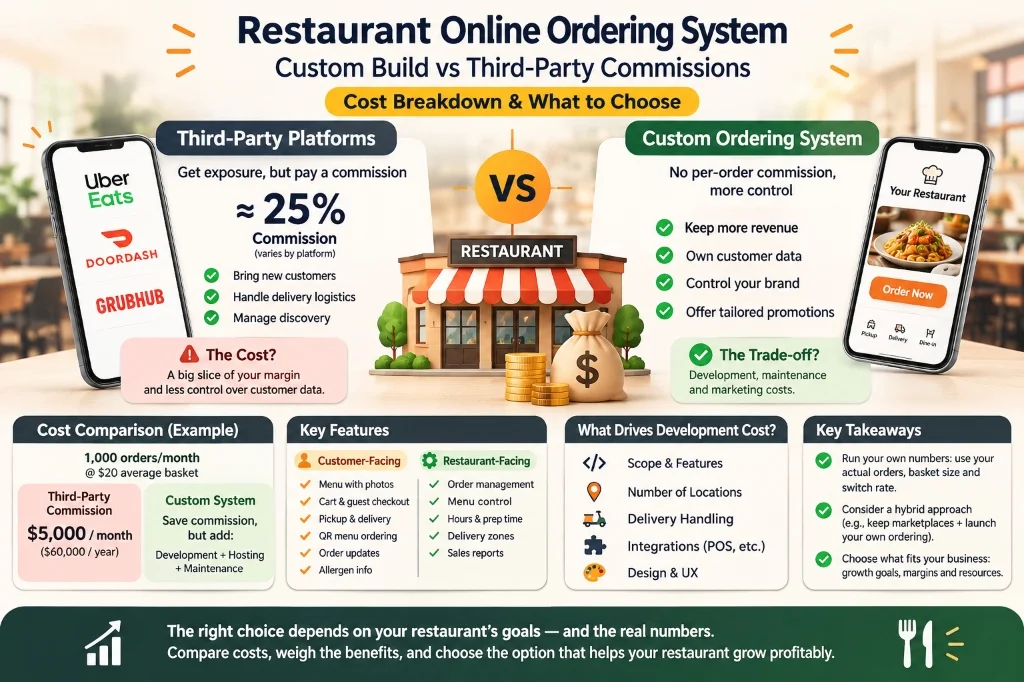
Every online order that comes through a delivery marketplace leaves a slice of the bill with the platform. For a restaurant working on tight margins, that slice can decide whether an order makes money or loses it. This is why many owners start asking whether they should run their own ordering system instead.
The answer is not automatically yes. A custom system removes per-order commission, but it adds build costs, running costs and responsibility. This guide shows how to compare the two on real numbers, which features matter, what drives development cost, and when a hybrid approach makes more sense than choosing a side.
Investing in dedicated restaurant online ordering system development allows food and beverage operators to escape predatory commissions, yet it demands a clear understanding of the financial break-even point.
How Third-Party Commissions Work
Delivery and ordering marketplaces typically charge restaurants a percentage of each order, and sometimes extra fees for promotion, delivery or premium placement. Rates and terms differ between platforms, countries and contract tiers, so check your own agreement instead of relying on a general figure.
Those platforms do offer something in return. They bring customers who might never have found you, handle discovery, and in many cases manage delivery logistics. For a new restaurant, that exposure has real value.
The cost is the margin. Commission is charged on the order total, so it hits hardest on lower-priced items and on restaurants already operating on thin margins. Customer data also tends to stay with the platform, which makes repeat business harder to build directly.
A Simple Way to Compare the Costs
Instead of searching for one universal figure, run your own numbers. Use a worked example with round, hypothetical values, then replace them with yours.
Suppose a restaurant takes 1,000 online orders a month with an average basket of 20 units of currency, and a marketplace charges a 25% commission. Commission would be 5,000 a month, or 60,000 a year. Those figures are illustrative only, not a quote or an industry average.
Now compare that with the monthly cost of a custom or subscription-based system:
- Commission saved: orders moved to your own channel multiplied by average basket and your platform's rate.
- Costs added: development or subscription fees, hosting, maintenance, payment processing, and any marketing needed to send customers to your own ordering page.
- Break-even: when savings exceed added costs.
Two cautions apply. First, payment processing fees still exist on your own system, since card processors charge for transactions wherever the order is placed. Second, only the orders you actually move to your own channel count as savings. Many operators seek to avoid delivery commission by shifting regular diners to direct ordering channels, but if marketplace customers do not switch, you save nothing.
What a Custom Ordering System Gives You
A system you control offers advantages beyond commission savings:
- Customer relationships: You own the contact data and order history, subject to privacy rules, which supports repeat-order campaigns.
- Brand control: The ordering experience looks and feels like your restaurant, not a marketplace listing among competitors.
- Menu and pricing flexibility: You can run your own promotions, bundles and delivery fees.
- Operational fit: The system can match your kitchen workflow, opening hours and preparation times.
- Integration options: Connecting the ordering workflow with in-house hardware keeps operations smooth. Understanding what a restaurant POS system is clarifies how digital orders sync seamlessly with kitchen ticket printers and inventory counts.
The trade-off is responsibility. You handle uptime, support, updates and marketing, and no marketplace brings you customers by default.
Core Features of a Restaurant Ordering System
Not every restaurant needs every feature. When planning restaurant online ordering system development, prioritizing essential features first helps launch an MVP without scope creep:
Customer-facing features
- A clear, mobile-friendly menu with photos, descriptions and modifiers such as sizes and add-ons.
- Cart and checkout with guest ordering, so customers are not forced to register.
- Pickup, delivery and, where relevant, dine-in options.
- Table-side QR menu ordering for dining rooms, which lets guests order and pay directly from their phones.
- Order status updates by on-screen message, email or SMS.
- Allergen and dietary labelling, subject to the rules in your jurisdiction.
Restaurant-facing features
- A kitchen or order management view that shows new orders clearly.
- Menu management, including item availability and sold-out toggles.
- Opening hours, preparation times and order throttling for busy periods.
- Delivery zones and fees, where you run your own delivery.
- Reports on sales, popular items and order times.
Payments and security
Use an established payment provider with hosted payment fields or redirects, so card details never touch your own servers. This reduces your compliance burden and risk. Check which payment methods customers in your market expect, such as cards, digital wallets or local options.
What Drives Development Cost
The total budget for restaurant online ordering system development depends heavily on integrations, number of branches, and kitchen dispatch logic:
- Scope and feature count: A simple pickup menu is far smaller than a multi-location system with loyalty and delivery tracking.
- Number of locations: Multi-branch menus, pricing and reporting add complexity.
- Delivery handling: Running your own drivers, or integrating with delivery partners, needs mapping, zone logic and status tracking.
- POS and third-party integrations: Each connection needs design, testing and error handling, and quality of vendor documentation affects effort.
- Design: A tailored brand experience takes more design time than a standard template.
- Languages and regions: Multiple languages, currencies or tax rules add work.
- Admin tools: The more control staff need, the more interface there is to build and test.
- Testing and launch support: Real-world testing during a live service is worth planning for.
Evaluating benchmark figures for Next.js website development cost gives a clear baseline for custom web engineering budgets.
Structuring the architecture for scalable web application development ensures the backend handles Friday-night order spikes effortlessly as order volumes expand.
Costs Beyond the Build
The first version is only part of the picture. Plan for:
- Hosting and infrastructure: usually billed monthly.
- Payment processing fees: charged per transaction.
- SMS or email services: for order notifications.
- Maintenance and security updates: to keep dependencies patched.
- Support: when something fails during peak service hours.
- Marketing: since a custom system needs its own traffic.
A system that works perfectly but receives no orders saves no commission. Budget for the work of bringing customers to it.
Custom Build, Subscription Tool or Hybrid
There are three broad routes, and the right one depends on your volume and resources.
Subscription ordering software: Many vendors offer ready-made ordering for a monthly fee or a lower commission. It is quick to launch and cheaper upfront, with less control over design and data. It suits restaurants that want to start soon and test demand.
Custom build: For high-volume venues, custom restaurant online ordering system development offers full independence from marketplace commissions, bespoke kitchen integration, and complete data ownership.
Hybrid: Keep marketplace listings for discovery while steering repeat customers to your own ordering page. Many restaurants find this gives the best balance: marketplaces bring in new customers, and your own channel keeps the margin on regulars.
How to Move Customers to Your Own Channel
A system only pays off if people use it. A few practical approaches:
- Put a prominent "order direct" link on your website, social profiles and Google Business Profile.
- Add QR codes to packaging, receipts and table cards.
- Offer a modest direct-order benefit, such as a free side or a loyalty reward, where margins allow.
- Collect contact details with consent, then send relevant offers.
- Make sure the ordering page loads quickly and works well on phones.
Check the terms of any marketplace agreement before running promotions, since some contracts restrict how you promote direct ordering.
Local Visibility and SEO
Your own ordering site also helps customers find you in search. A fast restaurant website with clear menus, opening hours, address and an order button supports local search visibility. Keep menu pages crawlable, use structured data where appropriate, and keep business details consistent across your website and listings.
Specialized engineering in custom web application development enables direct integration with local payment gateways, dispatch drivers, and customer loyalty databases.
Frequently Asked Questions
Is a custom ordering system always cheaper than paying marketplace commission?
No. It depends on your order volume, how many customers will switch to your channel, and the build and running costs. Run the comparison with your own numbers before deciding.
Do I still pay fees on my own ordering system?
Yes. Payment processors charge transaction fees, and you will have hosting, maintenance and notification costs. What you avoid is the per-order marketplace commission.
Can I keep marketplace listings and run my own system?
Usually yes, and many restaurants do. Review your marketplace contract for any restrictions on promoting direct orders.
What is QR menu ordering?
Guests scan a code at the table, view the menu on their phone and place an order directly, often with payment included. It can reduce waiting time and staff workload, provided the kitchen workflow supports it.
Conclusion
Commission fees make custom restaurant online ordering system development worth evaluating, but the decision should come from your own numbers, not from the idea of "owning" the channel. Calculate the commission you would save, subtract the build and running costs, and be realistic about how many customers will order direct. For many restaurants, a hybrid approach works best: marketplaces for discovery, and a well-built ordering system of your own to keep the margin on repeat customers.
To evaluate whether building a proprietary ordering platform makes commercial sense for your kitchen, request a restaurant tech consultation.