Agencies tend to hit the same ceiling. Sales are going well, clients want modern, fast websites and web apps, and the in-house team is already full. Hiring a senior Next.js developer takes months and carries fixed costs whether or not the pipeline stays busy. Turning work away means losing revenue and, sometimes, the client.
Dedicated white-label web development offers a third option. A specialist team builds the project, your agency presents it under its own name, and you keep the client relationship. This guide explains how that arrangement works for Next.js projects, what to hand off, how pricing and quality control usually work, and what to settle in writing before the first brief goes out.
Marketing agencies, creative studios, and consultancies across professional services frequently encounter this delivery ceiling when client retainers expand rapidly.
What White-Label Web Development Means
White-label web development is work produced by one company and delivered to the end client under another company's brand. The client deals with your account managers, your project plan and your invoices. The partner stays in the background, working to your brief and your standards.
It is closely related to arrangements where firms subcontract web development, and the terms are often used interchangeably. The distinction is mostly about visibility. A subcontractor may be named in a contract or credited on a project. A white-label partner is invisible by agreement, which is why confidentiality terms sit at the centre of the arrangement.
For agencies, the appeal is flexibility. You can take on a project without adding permanent headcount, and you can scale delivery up or down as demand changes.
Why Next.js Specifically
Next.js is a React framework that supports server-side rendering, static generation and incremental regeneration, along with routing, API routes and built-in image handling. Agencies choose it for client sites where search visibility, speed and maintainability matter: marketing sites, e-commerce front ends, SaaS products and content-heavy platforms.
It is also a framework where depth of experience shows. Decisions about rendering strategy, caching, metadata and data fetching affect both performance and SEO, and mistakes are expensive to unwind later. If your team is more comfortable with design, content or paid media than with front-end architecture, partnering with an experienced white label next.js developer fills a critical operational gap.
What Agencies Typically Hand Off
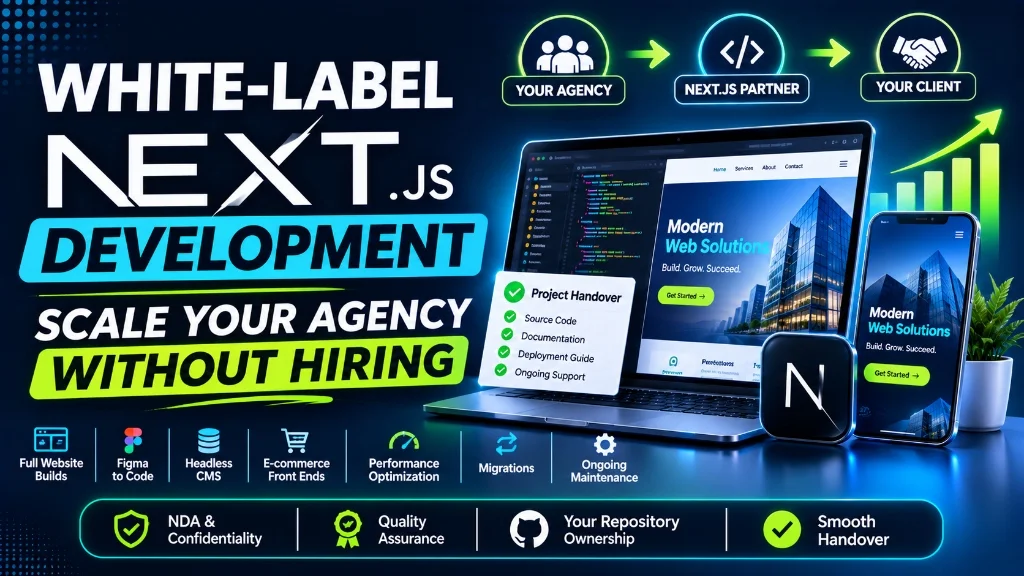
Almost any development task can be delegated, but some work packages suit white-label partners particularly well:
- Full website builds: Marketing sites, brochure sites and content platforms built from your designs.
- Design-to-code conversion: Taking approved Figma files and turning them into responsive, accessible components.
- Headless CMS integrations: Connecting Next.js to a content platform so clients can edit content without developer help.
- E-commerce front ends: Custom storefronts connected to a commerce back end.
- Performance and Core Web Vitals work: Diagnosing and fixing slow templates on existing builds. Resolving bottlenecks in Core Web Vitals and LCP in Next.js restores high-performance user experiences.
- Migrations: Moving a client from an older platform to Next.js without losing search visibility.
- Ongoing maintenance: Serving as a dependable agency overflow developer for dependency updates, bug fixes, and small feature requests.
Defined, repeatable projects are the easiest place to start. Large, ambiguous builds are better tackled after you have worked together and built trust.
How an Engagement Usually Works
Process matters more than any single developer's skill, because it is what keeps the project on track when something changes. A well-run engagement tends to follow these steps.
1. Brief and Scoping
You share the client's requirements, designs, content status and deadline. The partner reviews them, asks questions and returns a scope document and estimate. This is the point to flag unclear requirements, since vague scope is the source of most disputes.
2. Agreement and Access
Both sides sign an NDA and a service agreement. You provide repository access, design files and any accounts the partner needs, ideally under your agency's ownership instead of the partner's.
3. Build in Stages
Work is delivered in milestones, with staging links you can review and show to the client. Regular check-ins keep feedback flowing, and asynchronous updates such as short video walkthroughs help across time zones.
4. QA and Revisions
The partner tests across devices and browsers, checks accessibility basics, and fixes issues before you see the work. You then run your own review, and agreed rounds of revisions follow.
5. Launch and Handover
The partner supports deployment, then hands over documentation, credentials and a summary of how the site is built. A short warranty period for bugs found after launch is common.
Scope and Pricing Models
Specific rates vary widely, so no single figure will fit your situation. What you can compare are the structures, and each has trade-offs.
Fixed price per project: You know your cost before you quote the client, which makes margin planning simple. It works best when requirements are clear, and changes go through a change request.
Hourly or day rate: Better for exploratory work or ongoing support, but it leaves you carrying the risk if hours expand. Cap the hours or agree an estimate to keep it predictable.
Monthly retainer: A set number of hours or a dedicated allocation each month. Firms that outsource web development for agencies gain reliable capacity without a permanent payroll commitment.
Per-component or per-page pricing: Occasionally used for repeatable work such as templates, landing pages or component libraries.
When you resell, your margin is the difference between what you pay the partner and what you charge the client. That margin should cover your project management, client communication, QA review and the risk you take on. Resist the temptation to price purely at cost plus a small percentage, since you are the one accountable if something goes wrong. Examining the true drivers behind Next.js website development cost clarifies what increases or reduces an engineering budget.
Quality Assurance and Standards
Handing code to an external team does not remove your responsibility for quality. Protect the outcome by agreeing standards in advance:
- Coding conventions: A defined project structure and linting standards, so your own developers can pick the work up later.
- Version control: All branches and commits hosted in a repository you own, with meaningful commit history.
- Performance and accessibility targets: Automated checks with Lighthouse and accessibility tools before staging delivery.
- SEO foundations: Adherence to Next.js SEO best practices with dynamic metadata, canonical tags, automated XML sitemaps, redirects, and clean server-side rendering.
- A review stage: A designated buffer where your team validates the deliverable against the creative brief before client presentation.
Ask for a staging environment from day one so you can inspect progress rather than wait for a finished product.
Confidentiality and Ownership
White-label arrangements stand or fall on trust, so put the key points in writing:
- NDA: The partner agrees not to disclose your client's details or contact them directly.
- Non-solicitation: A clause preventing the partner from approaching your clients independently, with terms both sides consider fair.
- Branding: Code comments, commit messages, documentation and any visible footprint carry only your brand.
- Intellectual property: Ownership of code and assets passes to your agency or the client on payment, as agreed in the contract.
- Data handling: How credentials are shared, who has production access, and when access is revoked.
- Third-party licences: Who purchases and holds paid tools, fonts and plugins.
Have the agreement reviewed by a qualified legal professional in your jurisdiction, because rules on contractor status, IP and data protection differ between the US, UK, and other regions.
Choosing the Right Partner
Look beyond the portfolio. When choosing an engineering team for white-label web development, evaluate their communication discipline, code hygiene, and willingness to discuss technical trade-offs honestly.
- How do you handle scope changes and delays?
- How will we communicate across time zones?
- Can you show how you structure a Next.js project for long-term maintainability?
- Who reviews code before it reaches us?
- What support do you offer after launch?
Try a small, low-risk project first. A landing page set or a performance fix tells you more about reliability than any proposal does.
Frequently Asked Questions
What is the difference between white-label and subcontracting?
Subcontracting means delegating work to another provider, and the client may know about it. White-label means the partner stays completely anonymous, and everything is delivered strictly under your brand.
Who owns the code in a white-label project?
It depends on the contract. Most agreements transfer complete ownership of all repositories and intellectual property to the agency or the client upon final payment. Confirm this in writing before starting.
Can a white-label partner handle maintenance after launch?
Yes, many partners offer monthly retainers covering dependency upgrades, security patches, bug fixes, and minor enhancements. Always agree on response times and scope definitions in advance.
How do I protect my client relationship?
Use a strict mutual NDA and non-solicitation clause, route all communications exclusively through your account team, and ensure all repository commits and documentation carry your company's credentials.
Conclusion
Adopting white-label web development with Next.js lets an agency grow capacity without growing payroll. The model works when scope is clear, processes are agreed in advance, and confidentiality and ownership are written down rather than assumed. Start with a small project, judge the partner on communication and quality, and expand the relationship as trust builds.
If you are exploring a dependable technical partnership to scale your agency's development pipeline, reach out through our confidential agency consultation.